Optimizing a Mine Haul Truck
Wheel Motors’ Condition Monitoring Program: Use of ProportionalHazards Modeling
A.K.S. Jardine*, D. Banjevic*, M. Wiseman §
, S. Buck†, T. Joseph*,
*Condition-Based
Maintenance Laboratory, Department of Mechanical and Industrial Engineering,
University of Toronto
§PricewaterhouseCoopers,
Toronto
†Cardinal
River Coals Ltd., Alberta
Abstract:
The paper
discusses work completed at Cardinal River Coals in Canada to improve the
existing oil analysis condition-monitoring program being undertaken for wheel
motors.
Oil analysis
results from a fleet of 55 haul truck wheel motors were analyzed along with
their respective failures and repairs over a nine-year period. Detailed data
cleaning procedures were applied to prepare data for modeling. In addition,
definitions of failure and suspension were clarified depending on equipment
condition at replacement. Using the proportional-hazards model (PHM) approach,
the key condition variables relating to failures were found from among the 19
elements monitored, plus sediment and viscosity. Those key variables were then
incorporated into a decision model that provided an unambiguous and optimal
recommendation on whether to continue operating a wheel motor or to remove it
for overhaul on the basis of data obtained from an oil sample.
Wheel motor
failure implied extensive planetary gear or sun gear damage necessitating the
replacement of one or more major internal components in a general overhaul. The
decision model, when triggered by incoming data, provided both a recommendation
based on an optimal decision policy as well as an estimate of the unit's
remaining useful life (RUL). By optimizing the times of repair as a function
both of age and condition data a 20-30% potential savings in overhaul costs
over existing practice was identified.
Keywords: Wheel motors,
Condition monitoring, Oil analysis, Proportional-hazards modeling, Optimizing
condition-based maintenance decisions, EXAKT software
Practical Implications:
Current
practice for monitoring the health of items is through examining trends in
readings obtained from various forms of condition monitoring. Interpretation of
these readings is undertaken by an inspector reviewing current and past
readings, or through using commercially available trending software. Such an
approach does not guarantee that the full information-value contained in the
readings is captured. The paper uses a statistical procedure called
proportional-hazards modeling to identify the key measurements that should be
used to assess the true state of health of the equipment. Economic decision
rules are then established. The procedure is described through a case study
that reports on the optimization of condition-based maintenance decisions for
haul truck wheel motors that are monitored through oil analysis. Application of
the procedure demonstrated a 20-30% potential savings in overhaul costs
compared to current practice.
This paper
underlines the importance of data cleaning and applying a consistent definition
of failure based on both the observed equipment condition at repair time and
the inability of the equipment to perform its functions. (for additional
discussion see Campbell and Jardine 2001).
Introduction
Cardinal
River Coals Ltd. is a 50/50 joint venture between Luscar Ltd. and Consol of
Canada, Inc. The mine is located approximately 50 km south of Hinton, Alberta
on the eastern slopes of the Rocky Mountains. The coal produced from the mine
is low sulfur, high quality coking coal used for steel making. Cardinal River
Coals Ltd. opened in 1970 as a multiple open pit mine using the truck and
shovel mining method. Current annual production at the mine calls for the
removal of 21 million cubic metres of rock and 2.8 million tonnes of coal. The
mine has won multiple awards for the land reclamation and creating wildlife
habitat.
There are 26
haul trucks at the mine site, each having two wheel motors. With 3 spare wheel
motors the fleet numbers 55.The existing policy, based on experience, is to
rebuild the units after about 20,000 hours of operation. Oil analysis is
carried out monthly whereby the amount of sediment (weight of filter patch
filtrate) and parts per million (ppm) of five out of the nineteen elements are
noted: iron, silicon, chrome, nickel, and titanium. The decision to remove the
unit for rebuild is based on manual perusal of the values of these elements in
combination with the unit's age.
Wheel motor
failures relating to the electrical drive elements and braking system were not
included in this study since their condition is not reflected by oil analysis
data. Seal replacements were carried out frequently as a result of high
contamination and coincided with oil change outs. The oil change out event (OC)
is considered as a “minor” repair. The analysis shows that a high amount of
sediment persisting in spite of these corrective measures, is associated with a
high risk of failure.
Statistical
analysis of the CRC wheel-motor data showed a high correlation between iron and
silicon. That fact would support the view that there are a high number of
failures which are contaminant induced. Hence one may conclude that there is an
event or set of conditions that initiate a process of deterioration in the
wheel motor. It is assumed that by overhauling the unit before the damage
becomes more extensive one would benefit from savings through failure
avoidance.
Data Availability
Within the
mine’s computer maintenance management system (CMMS) there were histories of
wheel motor lifetimes, including details of removals due to failure or
preventive maintenance as a result of interpretation of the signals obtained
from oil analysis. Costs associated with the failure and preventive removals
were also available.
Additionally,
there was a database containing a vast history of condition monitoring test
results – some 50,000 records.
It may seem
that it would be an easy matter to peruse and study these two data sources and
learn which patterns of data have been associated with past failure, thus identifying
the data combinations that might be employed as condition indicators of future
failures. Unfortunately identification of the key condition indicators from
amongst all the data collected is seldom obvious to the analyst. The
complexity, volume, and time lags within the data render them elusive if not
impossible to discern without the proper tools.
In this
paper we show a tool that uses a statistical modeling technique known as
proportional-hazards modeling to bridge these two invaluable data sources. It
is the central function in a program called EXAKT developed precisely for this
purpose by the condition based maintenance (CBM) laboratory at the University
of Toronto (see Jardine et al, 1997).
Model Building: The Proportional-hazards Model (PHM)
The
Weibull-PHM (Equation 1) relates an item’s reliability to its working age and
to significant measured variables known as condition monitoring (CM) data.
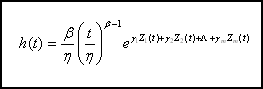
Equation 1 The proportional hazard model (PHM) with Weibull baseline
In Equation 1 h(t) is the (instantaneous) conditional probability
of failure at time t, also known as the hazard function, given the values of Z1(t),
Z2(t), … Zm(t). Each Zi(t) in represents a
monitored condition data item at the time of inspection. These measurements may
include the parts per million of iron or the vibration amplitude at the second
harmonic of shaft rotation, or any variable that reflects the accumulated
stress or damage with respect to some mode of failure. These condition data are
sometimes called covariates. The g’s are the covariate parameters weighting
the degree of influence each covariate has on the hazard function. The model
consists of two parts, the first part is a baseline hazard function (Weibull)
that takes into account the age of the equipment at time of inspection,  . The second part,
  , takes into
account the key variables and their associated weights.
, takes into
account the key variables and their associated weights.
Data Cleaning Related to Wheel Motor Event Records
The first
step in every proportional hazard model (PHM) building exercise is a thorough
examination of the data. The data-cleaning phase of PHM is considered the most
important one of the entire modeling process. If we are to accomplish our
objective of accurate and automated CBM data interpretation, the data upon
which we intend to build the model must be as free of error as is possible.
Much of this paper, therefore, focuses on the data investigative or cleansing
phase of model building.
Fortunately
software provides us with ample tools with which to “cleanse” the data. In Figure 1 we show a feature of the EXAKT
software (2) that discovers many logical data inconsistencies emanating from
the CMMS, thereby helping the analyst to make the corrections that will improve
the ultimate model’s precision.
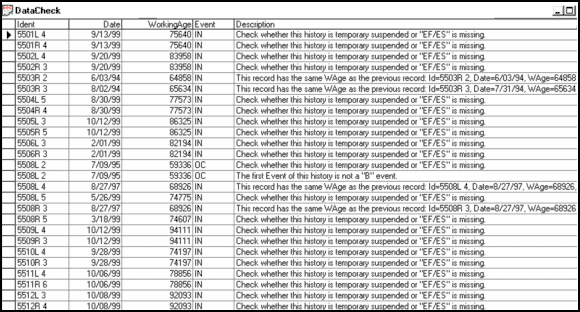
Figure 1 Data checking tool
Data
required for PHM analysis consists of "histories" or life-cycles.
Each valid history for a wheel motor must have a Beginning event (B), an Ending
event (EF for failure, or ES for suspension (such as a preventive removal)) and
Inspection events. A discussion of how suspensions and failures were determined
is given later in this paper. A history could also have events that are known
to affect covariates, such as oil change (OC) events.
The output
of the data - checking tool (illustrated in Figure 1) points out probable errors based on
a systematic evaluation of working ages and corresponding calendar dates as
reported in the CMMS. The software deduces, from the dates and working ages,
which inspection and event sets of data comprise individual histories. When it
finds a history without an ending reported, it asks whether the ending event
should be designated as a suspension (ES), a failure (EF), or whether the the
life-cycle has not yet ended. In this latter case, the software assigns it
temporary suspension event (denoted by *ES in the software) Temporary
suspension means that the item is still operating at the time of the data
analysis. Eventually that item, in the future, will end its life either by an
ES or EF event.
The software
also calls the analyst’s attention toanomalies that may indicate data problems
or errors. These will include two inspections on the same date (date and time)
or working ages and calendar dates that are out of synchronization. For example
an inspection at a later date may have a lower working age than an earlier
inspection. This is obviously an error in data transcription, which, if allowed
to persist in the data would compromise the model’s accuracy.
Most errors
can be easily be corrected, usually simply by inserting missing Beginning and Ending
events for each history.
Data Cleaning Related to Wheel Motor Condition Monitoring Records
Oil analysis
can be examined graphically using various combinations of covariates, dates,
ranges, and scales. Figure 2 reveals suspiciously unusual values of silicon
forming a horizontal line at exactly 900 parts per million (PPM). Condition
monitoring data rarely behaves so precisely.
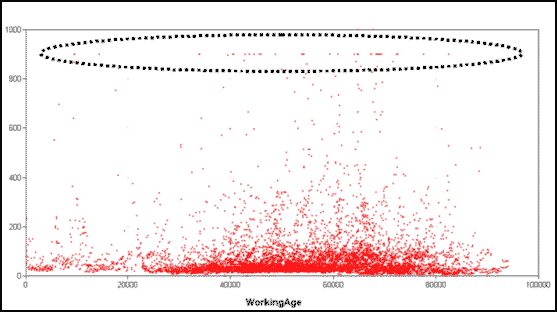
Figure 2 Graphical analysis of inspection records
Investigating
with the commercial laboratory it was found that for a period of time the
photo-multiplier tube on the spectrometer was saturating at exactly 900 PPM. In
other words all values of silicon above 900 were truncated to 900 PPM. A
similar situation occurred for iron above 2500 PPM. If not detected, this could
play havoc with the PHM.
It was
possible to compensate for the laboratory errors in preparing the data used to
build the model. For example, the truncated values of ‘Si’ they were replaced
with 1.2 x Fe. The factor of 1.2 was determined from the initial slope of the
cross graph (a correlation graph) of Fe-Si and values obtained after the
saturation defect was corrected. The truncated Fe values were not corrected
since there were too few of them to influence the model.
The
correction applied to the Si values is illustrated in Figure 3.
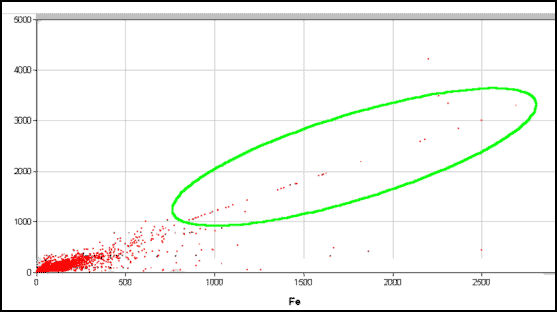
Figure 3 Corrected silicon readings
Cross graphs
of pairs of covariates are invaluable in finding correlations that are of great
help in developing and evaluating the eventual model.
Figure 4 shows the
correlation between iron (Fe) and nickel (Ni). Correlations between other
covariates were also tested. For example, Fe vs. Ti, Fe vs. Si and Ni vs. Ti graphs
all exhibited similar correlation.
Determining
correlation between covariates is useful both to provide insight into the data
and to understand the models generated by the software. For example, if ‘Fe’
and “Ni” are highly correlated the modeling process could indicate that there
is no point in including nickel in the model since it has been determined to
provide no additional information regarding the probability of failure.
These correlation could be the result of wear of a component whose metallic alloy
contains both iron and nickel.
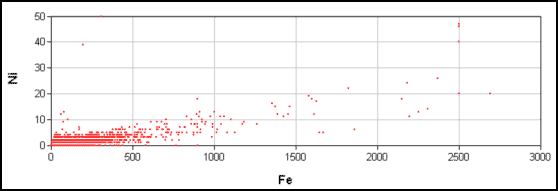
Figure 4 Correlating iron and nickel
Data Cleaning Related to Wheel Motor Oil Changes
When building the PHM it is necessary that
account be taken of any minor maintenance work, such as changing the oil in the
wheel motor. For example, Figure 5 illustrates that the
actual transition path of oil measurements was from A to B to C to D. If we did
not account for the oil change, then the modeling process would assume that the
transition was A to B to D. This would be misleading and would tend to
overestimate the risk of failure.

Figure 5 Correlating iron and nickel
In the EXAKT
data preparation phase, the model is told what covariate values should be
associated with those minor corrective events, such as an oil change (OC). Such
events could include calibrations or cleaning that would tend to reset certain
measurements but not materially zero-time the asset.
Figure
6
shows ‘missing’ or ‘irregular’ oil changes and obvious gaps. Calculations
indicate oil ages of 7000-8000 hours. Such extended oil usage is unlikely given
the use of mineral oils in this application. Obviously oil change events
occurred but were unreported in the CMMS. The site did change to synthetics
recently (1997) in order to eliminate the need for regular oil changes. However
most of the data covers the period prior to 1997. It was thought that this
information needed to be recovered from the commercial laboratory’s files.
Unfortunately these files, too, were incomplete and inconsistent with the dates
and working ages in the work order database.
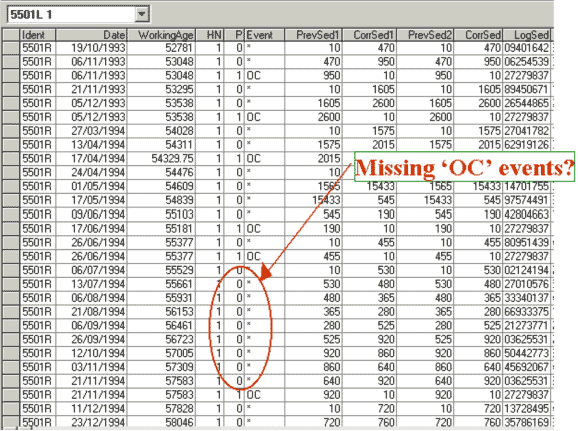
Figure 6 Missing oil change events
Happily, it
was determined that these 'missing' oil changes did not significantly affect
the model since they were relatively few in number (with respect to all of the
known oil changes). That is, there were a sufficient number of known oil
changes in the database for the model to account for their effect on the
measured data.
Building the Proportional Hazards Model (PHM)
After all the obvious data errors were
eliminated or corrected, the proportional hazard model could be generated by
the EXAKT software. As illustrated in Equation
1, the hazard function is the short term probability of failure
of an unfailed unit at a given point in time. It is a function of both working
age and the “significant” condition data. An iterative procedure in the EXAKT
software removes the insignificant covariates and weights the significance of
those remaining covariates found to influence the hazard. A number of candidate
models are then tested to see how well they represent the actual data. One of
the test methods used by the software is known as residual graphical analysis
illustrated in Figure 1.
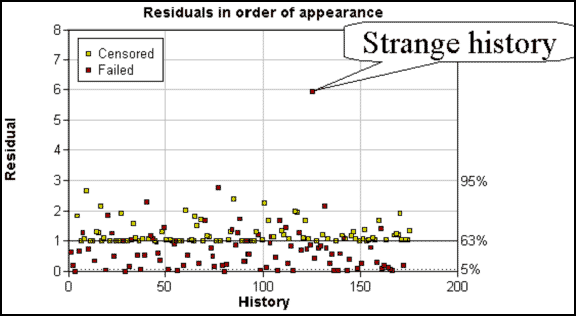
Figure 7 Residuals Graph
Each point
on the residual graph of Figure 7 represents a history
(the time from wheel motor installation to its removal for whatever reason).
The sample used to build the model consists of many histories. The graph shows
an unusual point that is well above the 95% upper limit. This leads one to
investigate the underlying data corresponding to this residual. It was
discovered that some ‘unusual’ data were included in that history which appear
to violate the model we are attempting to build.
The unusual
residual value was identified as corresponding to one particular history from
wheel-motor 5509R, with beginning event at 48900 hrs and EF (ending with
failure) event at 72005 hrs.
The
‘offending’ data is shown in Figure
8
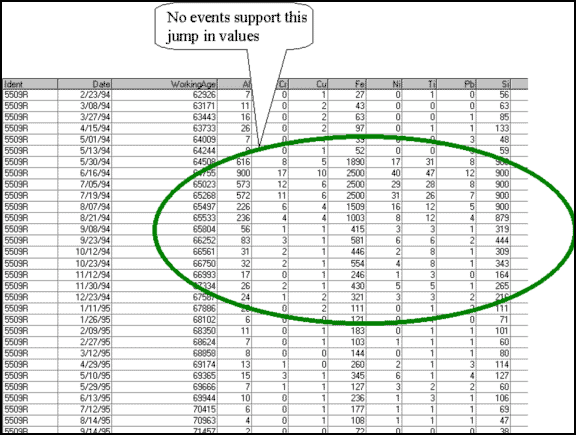
Figure 8 Investigating the strangeness
The Fe
values in the left-circled region of Figure
8
have an inexplicable pattern. Fe jumps to high values (but truncated at 2500
PPM due to instrument saturation) and remains in the same range for a few more
inspections. Then, the readings fall back to low values. No failure or
maintenance events were recorded to explain these sudden jumps.
Having no
event data to support such high values of Fe and Si, the offending history was
removed from the working data set, and, the model was regenerated. This time
statistical goodness-of-fit testing procedures and graphical residuals analysis
indicated immediate improvement of the model’s fit to the data. The model no longer had to accommodate obviously
contradictory and misleading information.
The failure definition problem
The forgoing
describes data problems which were encountered and which were relatively easy
to correct using the statistical and graphical tools available in the software.
However a
different (and more fundamental) problem occurred regarding the definition
of wheel motor failure. These units seldom failed “functionally”. There were
few “in-service” failures requiring that a haul truck be removed immediately
from operation. Nevertheless a predictive model requires an objective
determination that a unit had failed. It was, therefore, necessary to
scrutinize the past work order records to distinquish failures from preventive
removals. Initially, the tradesman remarks were used for this purpose, such as
"High iron in oil sample and high hours, removed and replaced wheel
motor." This event was then classified as a “failure”. However, on
reviewing the re-builder's report attached to each invoice it became clear that
some events initially classified as a failure should be treated as a suspension
(a preventive repair). For example: If the gears had been replaced because they
failed an ultrasonic test or they were obviously in a failed state then that
life-cycle’s ending event should be classed as a failure. But if gears or other
major components were replaced simply because it was expedient to do so, or if
the unit was only generally rebuilt with no real internal damage (or major
expense), then that history’s ending event should be considered a suspension.
With the
definition of suspension and of failure thus clarified, a proportional-hazards
model was re-built in the software and found to be a “good fit”.
The retained PHM
The model containing the covariates iron and
sediments was found to be good, both by graphical residual
analysis and by the Kolmogorov-Smirnov statistical test applied automatically by
the software. The results of the analysis are displayed in Figure
9. Covariate significance is tested by the Wald statistic,
the square of the standardized estimate of the parameter which follows a chi
square distribution with 1 degree of freedom. (Note: A few missing sediment
values had been replaced by the values from previous inspections prior to the
analysis, hence the reason for using the notation CorrSed in Fig. 9). The PHM
is thus:
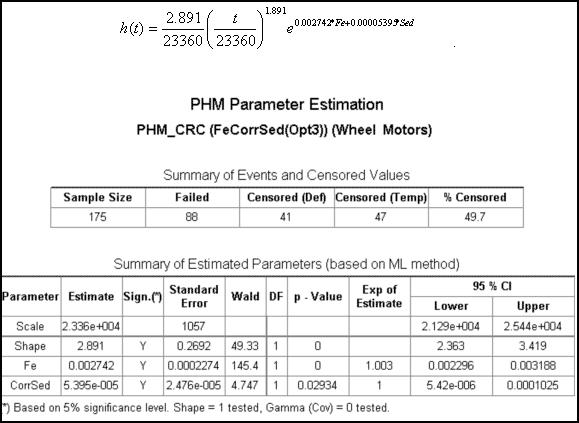
Figure 9 The Proportional Hazards Model
Obtaining the Decision Model
After determining the PHM we next proceed to
establish the optimal decision model (see Jardine et al 1997) that incorporates
economic considerations along with the risk estimate obtained from the PHM. The
decision policy was calculated with a cost ratio of 3:1 ($20K for preventive
replacement cost, $60K for failure replacement cost, based on the invoices of
past repairs by outside contractors See Figure
10). The cost ratio (between the cost of a failure and that of a
preventive repair) will vary amongst applications and even in the same
application at different times. Failure cost could include the costs associated
with operational consequences depending on current production and coal market
conditions.
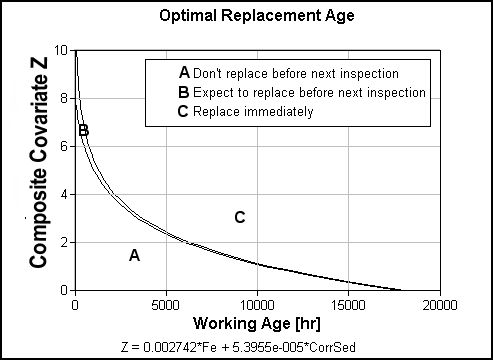
Figure 10 Decision Model Graph
The model includes the effects of regular
maintenance intervals (oil changes) at 500 hrs that occurred regularly during
most of the histories prior to the changeover to synthetic oil. A model
calculated without including the oil change intervals would tend to
underestimate predicted failure times. Oil change events are accounted for by
defining (in a database table called CovariatesOnEvent table) the values the
covariates would attain were an inspection carried immediately following the
(minor repair) event. The PHM parameters and transition probabilities are then
estimated from this adjusted data. In subsequent calculations we have to take
into account that covariates will regularly have their values reduced.
Otherwise covariates will reach high values in the calculation process faster
than in real data, and thus produce a higher estimated risk of failure than is
really the case.
At present
the model does not attempt to optimize inspection frequency (a future research
feature). Nevertheless, by inspection of the current data on the decision model
graph, one would likely choose to increase inspection frequency as the
composite covariate (the weighted sum of those variables found to be significant
risk factors) approached the boundary condition.
It is to be noted (in calculating the
benefits of the optimizing model) that no operational savings were accounted
for. This was due to the unfavorable coal market conditions at the time,
causing the mine to operate below its capacity. As market conditions improve
higher cost ratios will be used. Current strip ratios (total material removed
versus sellable material) would also affect the savings associated with
increased availability and reliability of each haul truck unit. Figure 11 demonstrates the sensitivity of the overall
savings to changes or inaccuracies in the cost ratio.
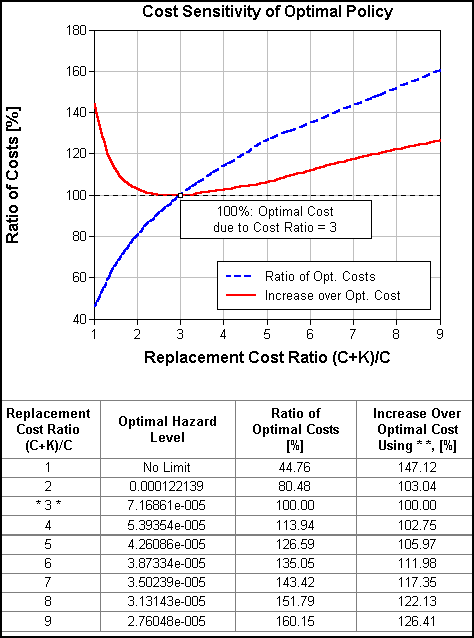
Figure 11 Cost Sensitivity Testing
In real
situations, the actual ratio of failure and preventive replacement costs may
not be well known. Furthermore the dynamics of industry are such that costs can
change with changing technology, production, and market conditions. Therefore
one should consider how the true total cost (of failure and preventive
maintenance when applying the optimal CBM interpretation policy of Figure 10)
would change with changes in cost ratio. The software enables sensitivity
analysis to be undertaken and generates a graph (Figure 11) and corresponding
tabular data.
The curves
on the graph are interpreted as follows.
Solid
Line:
If the actual cost ratio (CR) differs today from that specified when the model
was built, that means that the current policy (as dictated by the Optimal
Replacement Graph of Figure 10) may no longer be optimal. The line indicates
the cost percentage increase that will be incurred (above the optimal cost/unit
time for the actual cost ratio) by applying the “optimal” policy (which may no
longer be optimal). For example, if the actual cost ratio is 5 and we are using
a model which is based on CR=3, then the increase in the cost incurred by
following that (now non-optimal) policy is around 6% (5.98). In other words the
solid line represents the sensitivity of costs to changes in CR.
Dashed Line: Again, assume the
actual cost ratio has strayed from what was used when the model was built. If
the model is rebuilt using the new ratio the dashed line tells how much the new
optimal cost would differ from that of the original model. (Note that the
sensitivity graphs assume that only Cf (failure replacement cost)
changes and Cr (preventive replacement cost) remains unchanged.) In
other words the dashed line represents the sensitivity of the optimal policy to
changes in CR. The graph indicates that moderate overestimation of the cost
ratio does not significantly affect the average long run cost but provides a
more conservative policy from the point of view of risk of failure.
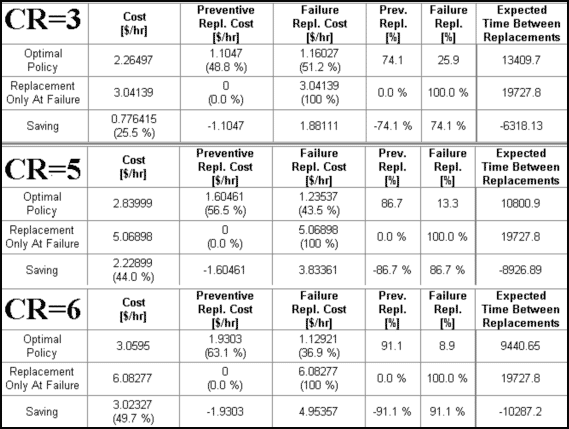
Figure 12 Savings predicted for different economic
conditions
The cost
analysis summary shown on Figure 12 indicates a saving of 25%, when CR=3, over
the “replace only on failure” policy. Those costs were found to be equivalent
to the site’s actual past policy. Hence, no real cost savings were derived from
the non-optimal oil analysis program that was in place.
Decision
model results are also calculated for cost ratios of 5 and 6. As the cost ratio
increases we can observe an increase in both the optimal policy cost as well as
an increase in savings. The optimal decision models in these cases indicate
that more frequent preventive replacements (from 74% to 91%) will result from
applying the optimal decision policy. However those preventive actions will
avoid a higher proportion of costs due to failure.
Applying the Decision Model
Once the decision model (of Figure 10) was
built, previous data was examined in order to see what the decision model would
have recommended prior to actual failure and preventive action. One
illustration of such a history is shown in Figure 13. This graph provides a
recommended decision based on inspection data (covariates and working age).
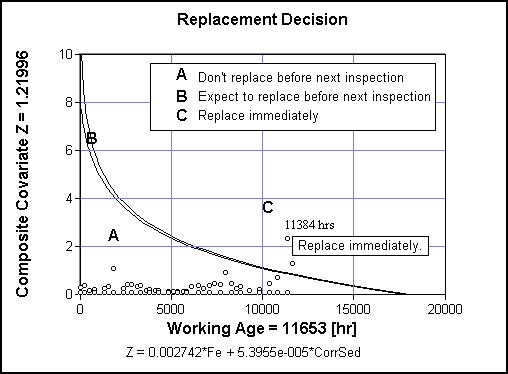
Figure 13 Retroactive application of the decision
model
The decision
‘Replace immediately’ was suggested by the model first at working age =
11384 hrs, 286 hours (about two weeks) prior to failure (reported at 11660
hrs). The following inspection (at working age = 11653 hours) 7 hours prior to
failure, also recommends the replacement of the wheel motor. The first warning
may have been sufficient, given sample turnaround time of 48 hours, to prevent
the consequences (high repair cost) of failure. Even prior to 11384 hours it
can be seen from the decision graph that the results of the measurements
indicate that a replacement recommendation was imminent. The zero points on the
graph indicate default measurement values of zero (imputed by the software)
immediately following oil changes.
An economic
benefit associated with basing the maintenance policy on the Decision Policy
Graph (of Figure 10). This investigation indicates a potential saving of
between 20%-30% compared to the current practice.
Conclusion
The case
study first demonstrates the value of using the technique of PHM to assist
maintenance professionals to interpret condition data by identifying the key
risk factors and their relative influence on the health of equipment in
general, and wheel motors in particular. Economic considerations were then
blended with the PHM risk model to identify the optimal decision chart. The
study then indicates that the implementation of a condition-based maintenance
strategy based on the decision chart would result in a cost reduction of
20%-30%.
References
Cox, D.R.,
(1972) “Regression models and life tables
(with discussion)”, Jury. Stat. Soc. B, Vol. 34,pp. 187-220.
Jardine,
A.K.S., Banjevic D. and Makis V, (1997) “Optimal
replacement policy and the structure of software for condition-based
maintenance”, Journal of Quality in Maintenance Engineering, Vol. 3, No.2,
pp. 109-119.
Campbell,
J.D. and Jardine A.K.S. (Editors), (2001)
Maintenance Excellence: Optimizing Equipment Life-Cycle Decisions, Marcel
Dekker, (Chapter 12: Optimizing Condition Based Maintenance, by M. Wiseman).